

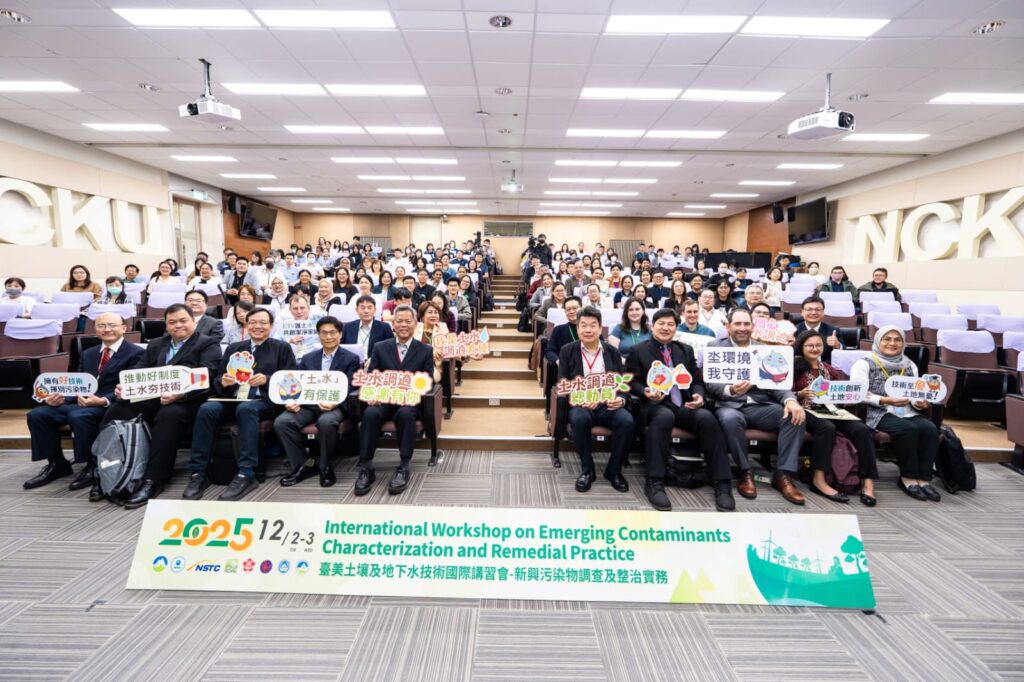
Universitas Pembangunan Nasional “Veteran” Jawa Timur reaffirmed its international presence by actively participating in two prestigious academic forums: The 2025 International Workshop on Emerging Contaminants Characterization and Remedial Practice (December 2–3, 2025) and The 2025 International Workshop on Sustainable Protection and Restoration of Soil and Groundwater and Resource Circulation (November 30–December 7, 2025). Both events were hosted by National Cheng Kung University (NCKU), Tainan, Taiwan, and served as key platforms for advancing global discourse on environmental sustainability and remediation technologies.
The workshops brought together participants from more than ten countries, including the United States, Australia, Japan, South Korea, Taiwan, Indonesia, India, Sri Lanka, Nepal, Thailand, the Philippines, Cambodia, and Vietnam. This diverse international participation fostered rich academic exchange, enabling researchers, practitioners, and policymakers to share experiences, scientific findings, and innovative solutions to address pressing environmental challenges at both regional and global levels.
Indonesia was represented by several leading institutions, with UPN Veteran Jawa Timur contributing prominently through its delegation of faculty members and researchers. The UPNVJT representatives included Prof. Euis Nurul Hidayah, MT., PhD; Dr. Aulia Ulfah Farahdiba, ST., MSc.; Ika Nawang Puspitawati, ST., MT.; and Nurvita Cundaningsih, S.Si., MT. The delegation also included an alumnus of UPNVJT currently pursuing a master’s degree in Taiwan, highlighting the university’s sustained academic engagement and global alumni network.
In addition to UPNVJT, Indonesia’s participation was strengthened by representatives from Institut Teknologi Sepuluh Nopember (ITS), Universitas Surabaya (UBAYA), Universitas Islam Indonesia (UII), as well as officials from the Indonesian Ministry of Environment. The presence of academic institutions alongside government representatives underscored Indonesia’s strong commitment to evidence-based environmental management and international collaboration in research and policy development.
A major focus of the workshops was the issue of emerging contaminants, particularly Per- and Polyfluoroalkyl Substances (PFAS), which have become a critical global concern. PFAS are known for their persistence in the environment and potential adverse impacts on human health. Participants engaged in in-depth discussions on advanced methods for PFAS detection, characterization, and innovative remediation strategies aimed at minimizing environmental risks and supporting long-term sustainability.
Beyond emerging contaminants, the workshops emphasized sustainable protection and restoration of soil and groundwater within the framework of circular resource management. Discussions highlighted integrated approaches that combine environmental protection, resource circulation, and technological innovation. These exchanges opened opportunities for future joint research projects, knowledge transfer, and the adaptation of best practices across different countries, including Indonesia.
UPN Veteran Jawa Timur’s participation in these international workshops reflects the university’s commitment to strengthening its global academic standing and advancing its role as a “Bela Negara” campus with international competitiveness. Through active involvement in global scientific forums, UPNVJT continues to contribute to environmental research, enhance the capacity of its academic community, and support the development of sustainable solutions with tangible impacts at national and international levels.